
Profit (economics)
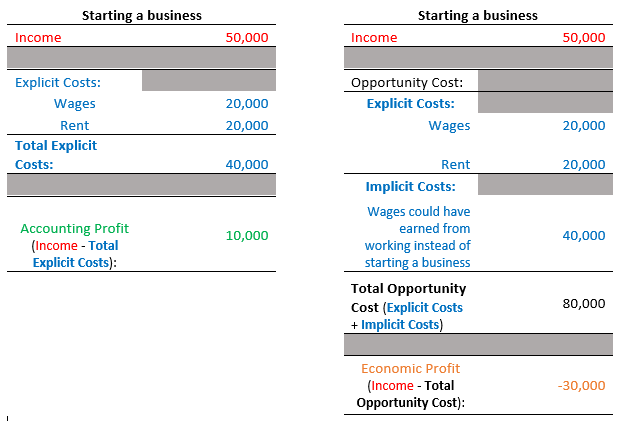
Economic profit is total revenue minus all explicit and implicit costs.

Goszei · CC0
In economics, profit is the difference between revenue received from outputs and total costs of inputs, also known as surplus value. It equals total revenue minus total cost, including both explicit and implicit costs, and differs from accounting profit, which only subtracts explicit costs. Normal profit occurs when total revenue equals total costs, resulting in zero economic profit, and represents the minimum profit level for a company to remain operational in a competitive industry.
- field
- Economics
- key_concept
- Economic profit vs. accounting profit
- related_markets
- Perfectly competitive, monopolistic, oligopolistic, contestable
- barriers_to_entry
- Patents, land rights, zoning laws
- government_intervention
- Competition laws, restrictions, subsidies
Lore & Background
Economic profit is smaller than accounting profit because it includes implicit costs. In perfectly competitive markets, long-run equilibrium eliminates economic profit, as new entrants increase supply and drive prices down to the minimum of long-run average costs. Normal profit occurs when economic profit is zero, indicating resources are used efficiently. In uncompetitive markets like monopolies and oligopolies, barriers to entry allow firms to maintain economic profit by setting prices above costs. Government intervention, such as competition laws, can prevent powerful firms from creating artificial barriers to protect economic profits.
Reader's Guide
Economic profit is a central concept in economics, distinguishing between accounting profit and true economic surplus. It arises in non-competitive markets with significant barriers to entry, such as monopolies and oligopolies, where firms can set prices above marginal cost. In perfectly competitive markets, long-run equilibrium eliminates economic profit, as firms enter or exit until price equals average total cost. Normal profit, where economic profit is zero, represents the minimum needed to keep a firm operational. The concept highlights inefficiencies in uncompetitive markets and justifies government intervention, such as antitrust laws, to prevent artificial barriers and protect consumers. Understanding economic profit helps analyze market structures, firm behavior, and the role of competition in resource allocation.
Did You Know?
- Economic profit is equal to total revenue minus total cost, including both explicit and implicit costs.
- Normal profit occurs when economic profit is zero, meaning total revenue equals total costs.
- In a perfectly competitive market, long-run equilibrium results in zero economic profit.
- Barriers to entry such as patents, land rights, and zoning laws allow firms to maintain economic profit in uncompetitive markets.
Definition and Applied Scope
Business economics sits at the intersection of economic theory and the practical realities of running a firm. Rather than remaining in the abstract, it functions as a tool for managerial decision-making and planning, extending traditional economic concepts into the day-to-day operations of enterprises. It draws primarily on microeconomics, organized into positive and negative analytical categories, while occasionally incorporating macroeconomic factors into its framework. The field examines why corporate firms emerge, why they expand horizontally, vertically, or spatially, and how they interact with employees, capital providers, customers, and government. It also addresses the role of entrepreneurs, the significance of organizational structure, and the broader business environment in which firms operate. The journal Business Economics has articulated its professional mission as delivering practical information to those who apply economics in their work, underscoring the discipline's commitment to bridging theory and practice.
Terminological Ambiguity and Distinctions
The label "business economics" carries no single, fixed meaning across the academic and professional landscape. In some contexts it is used interchangeably with industrial economics, industrial organisation, managerial economics, or economics for business, yet meaningful distinctions exist among these terms. Business economics is generally regarded as having a wider scope than industrial economics because it encompasses not only manufacturing industries but also service-sector businesses. Economics for business applies major economic principles to real-world commercial settings, while managerial economics is used more narrowly to describe the application of economic methods within the managerial decision-making process. The term also functions as a hybrid discipline, combining economic theories with relevant business management theories. It studies how economic theories are shaped by the actual performance of businesses and their activities in practice, making it a field where abstract models meet the messy reality of corporate operations.
Practical Application and Its Limits
A compelling illustration of business economics in action comes from the product life cycle theory, which maps a product's trajectory through introduction, growth, maturity, and decline from an economic perspective. Apple Inc., a multinational technology firm known for designing electronic products and software, exemplifies this framework. The iPhone has served as a major competitive advantage, generating substantial profits. Yet as the smartphone market entered its maturity-to-decline phase, intensifying competition eroded profit margins, prompting Apple to invest in new product areas such as electric vehicles. This case demonstrates how economic theories can inform strategic corporate decisions. However, scholars note a critical caveat: economic models rest on specific assumptions within a controlled modelling environment, whereas the practical business landscape is far more complex and unpredictable. Theoretical considerations do not guarantee accurate business decisions. Managers must therefore supplement economic frameworks with awareness of internal and external organizational factors when navigating real-world complexity.
Divergent Academic Interpretations
Universities around the world interpret and teach business economics through markedly different lenses. The University of Delhi structures its Bachelor of Business Economics program around cultivating an analytical and quantitative approach to problem-solving in a shifting corporate landscape, applying the latest techniques from both economics and business. In Spain, institutions including the Autonomous University of Barcelona, the Universidad Pública de Navarra, and the University of the Balearic Islands have developed a joint Master of Science in Management, Organization and Business Economics, deploying advanced tools from Neoclassical economics, New institutional economics, Statistics, Econometrics, and Operations research to train professionals in managing complex organizations. Harvard applies economic methods to practical business aspects including administration and management, while Chile's Universidad del Desarrollo follows this model with an added entrepreneurship component. The University of Miami frames the discipline as the study of how resources are used to produce, distribute, and consume goods and services, requiring analysis of banks, stock markets, government, labor negotiations, taxes, international trade, and environmental issues. Manchester, by contrast, emphasizes how businesses contribute to societal welfare rather than individual or firm-level outcomes.
Gallery

Frequently Asked Questions
Who is Profit (economics)?
Profit is the economic surplus left over after a firm subtracts every input cost—both explicit expenses like wages and raw materials, and implicit costs such as the opportunity cost of the owner's capital—from its total revenue. It functions as the core reward signal that steers capital across perfectly competitive, monopolistic, oligopolistic, and contestable markets.
What are Profit (economics)'s powers/role?
In the canon of market theory, profit acts as the primary incentive mechanism that pulls resources toward their most productive uses and away from inefficient ones. When barriers to entry such as patents, land rights, or zoning laws shield incumbents from rivals, they can sustain supernormal profits, which is why governments deploy competition laws and subsidies to rebalance the field.
How does Profit (economics)'s story end?
The narrative reaches its equilibrium—called normal profit—when total revenue exactly equals total cost, leaving economic profit at zero. At that threshold the firm still covers every explicit and implicit expense, so it can keep operating in a competitive industry, but it earns no surplus beyond the minimum needed to stay in business.
Why is Profit (economics) important?
Profit is the yardstick that separates a genuinely efficient enterprise from one merely breaking even on paper, because it forces the calculation to include opportunity costs that standard bookkeeping ignores. Without this signal, investors, managers, and policymakers would lack a reliable gauge of whether a business is truly creating value or simply consuming resources.
What's the difference between Profit (economics) and Accounting Profit?
Economic profit deducts both explicit out-of-pocket costs and implicit opportunity costs from revenue, whereas accounting profit subtracts only the explicit, recorded expenses. As a result, a firm can post a positive accounting profit yet still sit at zero—or even negative—economic profit if the owner's capital would earn more elsewhere.
More in Economics And Business 1-17
Spotted an error? Know more?
This is a living reference — every entry is fact-audited, and reader corrections feed straight into our audit queue. Suggest an edit · See this site's audit record